7 Signs You're in the AI Career Trap — And the 3-Step Exit
In this article
- Nobody Said It Out Loud — And That's the Problem
- The Numbers Nobody Is Putting in the Same Paragraph
- Are You Exhibiting These 7 Signs? Most Developers Are Too Embarrassed to Check
- What the "Just Become an Orchestrator" Crowd Won't Tell You
- The Traps That Will End Your Career Quietly
- The Only 2 Skills That Will Still Be Worth $500k in 2028
- The One Decision That Separates the Augmented from the Replaced
- ❓ FAQ — For the "People Also Ask" Reader
The most dangerous thing Dario Amodei said at Davos wasn't that AI would replace software engineers. It's that he no longer writes code — and nobody in the room found that remarkable.
Spotify's co-CEO confirmed his best developers haven't typed a function definition since December.
A fractional CTO at a Series B startup now writes English specifications every morning instead of opening his IDE.
This isn't a prediction. It's already the present tense.
⚡ TL;DR
-
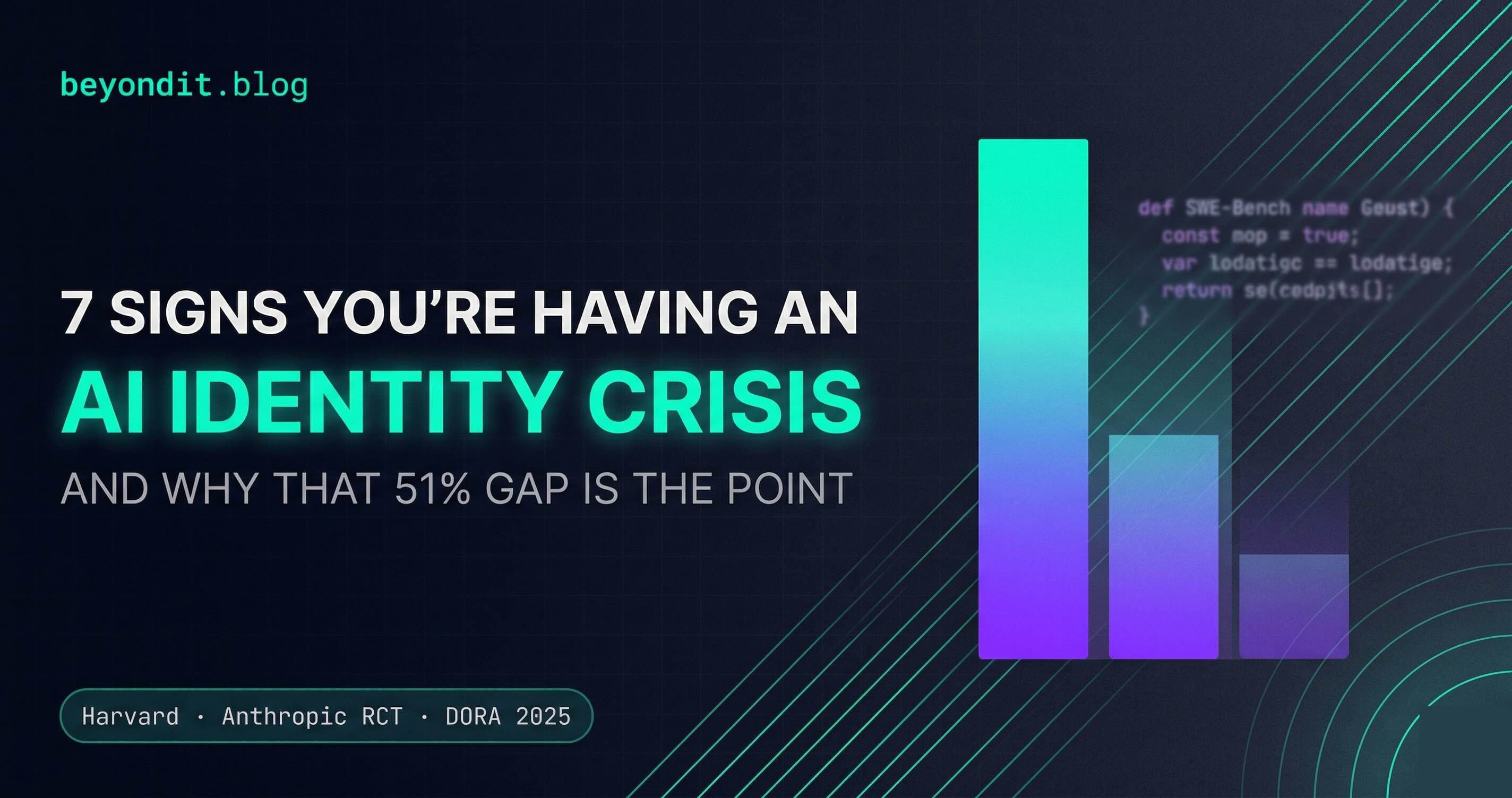
The 51-point gap is the story. 84% of developers use AI daily. Only 33% trust what it produces. That gap — between adoption and confidence — is the numerical fingerprint of a profession in collective denial.
-
The data isn't kind. Junior hiring is down 73% year-on-year. Entry-level unemployment has doubled. And AI models that score 70–80% on public benchmarks score just 23% on sealed, contamination-free ones. The headline numbers are lying to you.
-
Three things are quietly ending careers. Comprehension Debt — code your team ships but nobody understands. Licence Laundering — AI-generated code carrying GPL obligations you never agreed to. And Reviewer's Fatigue — the point where "it passes tests" becomes the only quality bar anyone enforces.
-
There are three paths forward. Not one. Not "just learn to prompt better." Three — and which one is right for you depends on your employer's governance readiness as much as your own skills. The framework is in here.
-
The Verification Premium is real. Classical CS — distributed systems, algorithmic reasoning, security threat modelling — is now the highest-compensated skill in engineering. Not because it's rare. Because it's the only thing that catches what AI produces with complete confidence but gets catastrophically wrong.
Full breakdown, data sources, and the career framework below. ~10 min read.
Nobody Said It Out Loud — And That's the Problem
The Davos Quote Everyone Misread
At the World Economic Forum in January 2026, Anthropic CEO Dario Amodei stated — on record — that AI could execute "most, maybe all" of software engineering end-to-end within six to twelve months.
His evidence was internal: Anthropic engineers had already stopped writing code manually and were directing, orchestrating, and editing AI outputs instead.
Most developers heard: "You're being replaced." That's not what he said.
What he actually said amounts to something far more unsettling: he no longer writes code — and the industry's most powerful room didn't flinch. The silence wasn't shock. It was recognition.
Boris Cherny, creator of Claude Code at Anthropic, went further. In his own words:
"The title 'software engineer' is going to start to go away. It's going to be replaced by 'builder,' and it's going to be painful for a lot of people."
And Anthropic's own hiring data quietly dismantles the obsolescence narrative: their open senior engineering roles surged 172% between January 2025 and February 2026.
The profession isn't dying. But the definition is cracking — and most developers are pretending not to notice.
"6 Months, 6 Months Ago" — Why Scepticism Is Both Valid and Dangerous
Developer communities on r/ClaudeCode coined a phrase that neatly captures collective exhaustion: "6 months, 6 months ago." It mocks the perpetually shifting automation timeline — a goal-post-moving tradition perfected since the early promises of self-driving vehicles.
That scepticism is historically informed and entirely warranted. AI agents fail catastrophically when navigating decades-old spaghetti code or untangling politically charged stakeholder requirements.
But dismissing the signal entirely is precisely how professionals miss the structural shift happening beneath the hype. The wave doesn't care whether you believe in it.
The Numbers Nobody Is Putting in the Same Paragraph
What the AI Code Generation Data Actually Shows
Start with what's verifiable.
GitHub's Octoverse data places 51% of all platform-committed code as AI-generated or substantially AI-assisted — up from 27% in 2022.
Enterprise adoption sits at 84–97%, with Java and Python seeing 61% and 55% machine-generation rates respectively.
Here's the number missing from every vendor case study. Google's Sundar Pichai confirmed 25–30% of new Google code is AI-generated.
The velocity gain is real — but raw lines-of-code volume and actual engineering productivity don't scale linearly. Writing more code faster doesn't mean shipping more reliable systems faster. Conflating those metrics is how organisations build themselves into a corner.
The most honest measure of AI capability isn't self-reported volume — it's the SWE-Bench Pro leaderboard from Scale AI's SEAL programme.
This benchmark uses private, sealed repositories that frontier models haven't encountered during training. That distinction matters: SWE-Bench Verified — the widely-cited benchmark — uses public Python repositories models have almost certainly memorised, producing inflated scores. Think of it as the difference between a practice exam and the real one.
Under contamination-free conditions, GPT-5 and Claude Opus 4.1 score just 23.3% and 23.1% respectively — versus 70–80%+ on Verified.
Even with optimised agent scaffolding (systems using multi-agent verification loops and RAG), the best-configured systems reach only ~46% on SWE-Bench Pro.
The gap between the benchmark headline and production reality is not a rounding error. It's the entire argument.
The Junior Hiring Collapse Is Not a Rumour
📊 Market Signals: Developer Hiring Crisis 2026 Source: byteiota.com — Developer Hiring Crisis 2026
-
Big Tech Junior Hiring Share 32% of total hires in 2019 → 7% in Q1 2026 Down 78% in seven years. The talent pipeline isn't slowing — it's collapsing.
-
Global Entry-Level Hiring Baseline 2024 → −73% year-over-year The steepest single-year contraction in the profession's recorded history.
-
CS Graduate Unemployment Under 3% historically → 6–7% in 2026 Doubled. Degrees that once guaranteed interviews no longer guarantee callbacks.
-
Senior Developer Salary $165,000 average in 2025 → $235,000 in 2026 Up 42% in twelve months. Senior engineers are scarce, leveraged, and expensive.
-
Tech Job Search Duration 2–3 months → 5–6 months, 200+ applications The search has doubled in length. The competition has multiplied.
Read those signals together — not individually.
A Harvard study by researchers Hosseini and Lichtinger found that companies adopting generative AI reduced junior developer hiring by 9–10% within six quarters whilst senior roles held steady.
This is what Forbes labels the "One Senior Ratio": senior engineers now generate 2.4× more AI-assisted output than junior developers, making an already-expensive tier the only economically rational hire.
Junior job postings grew 47% between late 2023 and late 2024. Actual hiring into those roles dropped 73% in the same window.
Companies are advertising junior positions to project growth and quietly filling them with displaced mid-level engineers willing to accept lower compensation.
That is not restructuring. That is a bait-and-switch.
[!WARNING] If you're an engineering manager or CTO: every junior role you didn't hire in 2026 is a senior architect your organisation won't have in 2032 — a shortage Gartner forecasts will affect 80% of engineering organisations as those who skipped the junior pipeline discover there is nobody left to govern their AI systems. The window belongs to you — and it is narrowing.
Are You Exhibiting These 7 Signs? Most Developers Are Too Embarrassed to Check
Sign 1–3 — The Behavioural Tells
Sign 1 — The IDE Stare. You open VS Code. You stare at a blank file for four minutes. Then you close it and open Claude Code instead.
You call it a productivity decision. It's avoidance — the moment your instinct to write something has been overridden by the instinct to prompt something.
That's not a workflow shift. It's an identity shift dressed up as efficiency.
Sign 2 — The Review Dread. You used to enjoy code review. Now it's the worst hour of your day.
The 2025 DORA report from Google found that a 90% increase in AI adoption correlates with a 154% increase in average pull request size and a 91% increase in code review time.
The PRs in your queue are dense, verbose, and written in a style nobody on your team consciously chose.
And the most dangerous outcome of that relentless machine-generated deluge? Reviewer's Fatigue — the point at which engineers begin rubber-stamping AI output because the volume is structurally impossible to scrutinise.
That's not a quality gate. It's quality theatre.
Sign 3 — The Competence Paradox. You're shipping faster than at any point in your career. And you feel less capable than ever.
Stack Overflow's 2025 developer survey confirmed this isn't a personal quirk: 84% of developers use AI tools daily — but only 33% trust the accuracy of those outputs, whilst 46% actively distrust them.
That 51-point gap between adoption and trust is the numerical fingerprint of a profession in collective denial. It's the 51% the headline is about — and it's precisely where the AI identity crisis lives.
Sign 4–5 — The Cognitive Signals
Sign 4 — The Comprehension Gap. Plain English first: Comprehension Debt is the gap between how much code exists in your production system and how much of it any human on your team actually understands.
Here's what it looks like in practice. An AI agent generates a multi-step regex to parse incoming webhook payloads. It passes all tests. It merges.
Six months later, the payload format changes slightly. Nobody can safely modify the regex — the pattern was generated, tested, and accepted without a single human constructing the logic.
The team rewrites it from scratch. That rewrite is Comprehension Debt being repaid with interest.
This isn't just an anecdotal headache; it's a measurable cognitive decline.
Anthropic's peer-reviewed RCT found that developers using AI assistance scored 17% lower on follow-up comprehension assessments than those who worked through problems manually — even when their code worked perfectly.
The codebase grows. The team's mental model of it shrinks. Those two curves are on a collision course.
Sign 5 — The Prompt Amnesia. You've shipped code you cannot fully explain — not because it's complex, but because the reasoning existed only in a chat window that closed the moment you ran the tests.
GitClear's analysis of 153 million lines of code found code churn has doubled since widespread AI adoption.
Copy-pasted and duplicated code is up 48%. Manual refactoring has collapsed from 25% to under 10%.
[!CAUTION] Example: A payments team at a Series B fintech merged an AI-generated transaction-routing module in November. By February, a production incident surfaced — incorrect currency rounding on multi-currency payouts. The postmortem found zero documentation of why the routing logic was structured as it was. Four engineers approved the PR. Nobody could reconstruct the reasoning because the Claude Code session had been closed six weeks prior. The "theory of the system" had simply ceased to exist.
Sign 6–7 — The Career Identity Fractures
Sign 6 — The Title Anxiety. I'll admit it: I've Googled "what do senior engineers actually do when AI writes the code" at 11pm. Not in crisis — just in the complete absence of an honest public answer.
Threads on r/ExperiencedDevs discussing the shift in daily engineering workflows routinely hit 40,000+ views.
The anxiety isn't irrational. It's a rational response to a professional identity that has been structurally destabilised without an honest conversation about what comes next.
Sign 7 — The Loyalty Contradiction. Anthropic's CEO declared software engineers might be obsolete within twelve months — at Davos, on the global stage. His company then posted 117 open senior engineering roles, a 172% increase from January 2025.
That contradiction is the most important data point in this entire article.
The industry doesn't need fewer engineers. It needs different ones — engineers who can evaluate, constrain, and govern AI output under production pressure.
This is the Verification Premium: the near-total shift of engineering value from writing code to rejecting the wrong code that AI produced with complete confidence.
"You're not reviewing code anymore. You're auditing machine output — and the volume is winning."
Knowing you're in crisis is the first step. Knowing which door to walk through is the only question that matters.
What the "Just Become an Orchestrator" Crowd Won't Tell You
The Three-Path Career Bifurcation Framework
Bifurcation (plain English): the point at which a single path splits into distinctly different directions — and your choice determines the trajectory.
Every article on the AI identity crisis ends identically: "Don't worry — just learn to direct agents and you'll be fine." It's the therapeutic conclusion the entire SERP has agreed upon.
In many cases, it's wrong.
Here is the decision framework the industry refuses to publish plainly:
| Path Name | Profile / Prerequisites | Role & Trajectory | Estimated 2026 Compensation |
|---|---|---|---|
| Path A: AI Architect / Systems Director | Deep CS fundamentals, high tolerance for ambiguity, employer supports agentic governance. | Role: You own architecture. Agents execute under your constraints. Trajectory: High leverage, irreplaceable through 2030+. | $235,000–$500,000+ |
| Path B: AI Engineering Coordinator | Strong domain knowledge, your code comprehension exceeds your AI output volume. | Role: Validate output. Enforce SDLC governance. Own human-AI handoffs. Trajectory: Fastest-emerging title in enterprise tech. | $140,000–$200,000 |
| Path C: Strategic Market Transition | Your current role is structurally deprecated, but your baseline skills are highly transferable. | Role: Move to adjacent domains (Tech Writing, Solutions Arch, Dev Rel). Trajectory: Market arbitrage. Deliberate pivot before the market forces it. | Variable |
Path C is not a failure state — it is a Strategic Market Transition.
Research tracking junior and mid-level developer employment in 2026 confirms a measurable segment of the profession is already exiting — not from lack of talent, but because the specific role they trained for has been structurally deprecated by the market.
The move is to where those skills are undervalued in their current context and overvalued in an adjacent one — and made deliberately, on your own terms, before the market moves for you.
How to Audit Your Employer Before You Audit Yourself
Before deciding which path to pursue, answer one prior question: does your current employer's environment actually support the identity shift you're considering?
Run the 5-Question Employer Readiness Test:
- Does your organisation have defined governance for agentic AI workflows in production?
- Is there a formal policy requiring prompt archiving alongside Git commits?
- Does your team have a dedicated SDLC review stage specifically for AI-generated output?
- Are senior engineers evaluated on architectural governance — or still primarily on PR throughput?
- Does leadership understand the difference between generation velocity and sustainable production velocity?
| "No" Answers | Assessment | Your Immediate Next Step |
|---|---|---|
| 0–1 | Governance-ready organisation | Proceed to Path A — your environment supports the shift |
| 2–3 | Governance-developing organisation | Propose one concrete governance change; reassess in 90 days |
| 4–5 | Vibe-coding shop | Choose Path B or C — don't bet your career on this employer's readiness |
Organisations already mapping their governance posture against the NIST AI Risk Management Framework (AI RMF 1.0) or ISO/IEC 42001 will find this Readiness Test maps directly onto their Govern and Measure function requirements — it's not a new framework. It's the one you're probably already being audited against.
[!NOTE] Example: Two Series B fintech companies, identical team sizes. Company A uses Claude Code with constrained system prompts and defined tool access scopes, routing all AI output through a LangGraph deterministic workflow graph (an open-source library for building structured, auditable multi-agent pipelines) with mandatory security gates before any merge. Company B runs unconstrained agent sessions with no governance layer. After six months: Company A's codebase tripled with security posture intact. Company B is mid-incident — an AI-generated authentication misconfiguration passed four rounds of review, and nobody can explain the logic because the prompt was lost at commit time.
The "Architect-Led, Agent-Executed" model works. But only inside organisations that have built the infrastructure for it.
The Traps That Will End Your Career Quietly
The Velocity Trap — "It Compiles" Is Not a Quality Bar
The 2025 DORA report from Google found that a 90% increase in AI adoption correlates with a 154% increase in average PR size and a 91% increase in code review time.
AI isn't accelerating your reviews. It's generating a volume that makes meaningful scrutiny structurally impossible.
And that's before you account for what's inside those PRs.
Here are the five production threats nobody puts in the same paragraph. Every one of them is already active in codebases right now.
1. The DORA Productivity Paradox
More AI → more code → more bugs, not fewer. The same DORA report documents a 9% increase in latent bug rates directly correlated with AI adoption. The velocity chart looks healthy. The incident log disagrees.
2. The Security Blind Spot
The Armis Labs Trusted Vibing Benchmark evaluated 18 leading AI models across 31 security scenarios. Every single model introduced critical vulnerabilities.
Failures clustered in SAML authentication, memory buffer management, file upload handling, and CI/CD access control.
Apiiro's Fortune 50 analysis documented a 10-fold monthly increase in security findings — roughly 1,000 to over 10,000 — between December 2024 and June 2025.
3. The Secrets Sprawl
GitGuardian's State of Secrets Sprawl 2026 recorded 29 million leaked organisational secrets in public GitHub commits — a 34% year-over-year increase.
The leak rate in AI-assisted commits is double the historical baseline for human-authored code. AWS keys, database credentials, and cryptographic tokens.
Not malicious. Just invisible to an agent that doesn't model threat surfaces.
4. The Licence Contamination Problem
AI models are trained on repositories carrying copyleft licences such as the GPL.
When they generate derived code without retaining the original licence information, your commercial product may carry obligations you've never agreed to — a pattern the 2026 Black Duck OSSRA Report calls "licence laundering."
Their audit found two-thirds of commercial codebases carried open-source licence conflicts. One codebase: 2,675 distinct violations.
Black Duck CEO Jason Schmitt: "The pace at which software is created now exceeds the pace at which most organisations can secure it."
5. The Governance Vacuum
This is not a future risk. It's an active governance failure running in production systems right now.
And the five threats above share a single root cause: AI agents that generate, commit, and deploy without a human ever asking "do we legally own this?" or "what attack surface did this introduce?"
[!IMPORTANT] CTO ACTION REQUIRED
Add one mandatory question to every AI adoption review: "Do we legally own this?"
The mitigation is specific. Implement automated Software Composition Analysis (SCA) with snippet-matching — tools such as FOSSA or Black Duck SCA — that scan AI-generated output for licence provenance before it reaches production. This converts an unquantified legal liability into a managed, auditable risk. Organisations already aligning to the NIST AI Risk Management Framework or ISO/IEC 42001 will find this maps directly onto their Govern and Measure function requirements.
It's not a nice-to-have. It's a governance requirement.
When reviewers face a relentless machine-generated deluge of 154% larger PRs and "it passes tests" becomes the quality bar, brittle architectures merge into production without a single human fully understanding them.
That's not engineering at scale. That's engineering debt at scale.
Comprehension Debt — The Technical Liability Nobody Is Tracking
One sentence: Comprehension Debt is the gap between how much code exists in your system and how much of it any human actually understands.
Traditional technical debt is a conscious compromise — a developer takes a deliberate shortcut, leaves a comment, and the team knows exactly where the structural problem lives.
Comprehension Debt is categorically different. It's invisible, unintentional, and compounding exponentially.
Here's the mechanism: an engineer prompts an AI to solve a complex routing problem. The AI produces a dense, mathematically optimised solution in thirty seconds.
The engineer runs the tests, confirms it works, and commits. The exact moment that code merges, the context — the prompt, the constraints, the architectural reasoning — evaporates entirely.
No comment. No reasoning trace. No record of the alternatives the model considered and rejected.
I've reviewed code I approved three weeks earlier and had no idea why the routing logic was structured the way it was. Not because it was complex — because I never wrote it, and I never asked why.
Addy Osmani's analysis of the 80% problem in agentic coding frames this exactly: AI takes you to 80% completion, but what's left has changed.
It's not the remaining implementation — it's the absence of understanding of the 80% the AI already produced.
Anthropic's peer-reviewed RCT found a 17% comprehension score drop in developers who consistently bypassed the problem-solving process.
The dependency doom loop follows: engineers become reliant on AI agents to decipher the legacy code that previous AI agents wrote.
At industrial scale, the industry is already building the infrastructure for that loop.
🗂️ What a "Theory of the System" Document Looks Like:
It's not a wiki. It's a living ARCHITECTURE.md committed alongside your code. Three sections: Why (the problem this component solves and the constraints it was built under), How (the key decisions made and alternatives explicitly rejected), and What Changed (significant shifts and their rationale). Here's a filled example:
## ARCHITECTURE.md — Example Entry

### Transaction Routing Module (v2.3 — November 2025)

**Why:** Replaced v1 routing because multi-currency payouts were hitting
an ISO 4217 (the international standard governing currency codes and
decimal precision) minor-unit rounding edge case at high volume.

**How:** Delegated to Claude Code with explicit constraint:
"Use Decimal, not float, for all currency arithmetic."
Rejected first AI output — it used float internally. Regenerated.

**What Changed:** Switched from 3-decimal truncation to banker's
rounding (round-half-to-even). Prompt archived in
/docs/prompts/routing-v2.md for future reference.
This document is the "theory of the system" — and without it, you're managing a codebase that only AI can read.
The Only 2 Skills That Will Still Be Worth $500k in 2028
The "Verification Premium" — Why Classical CS Is the New Moat
The engineers best positioned to thrive in the AI era are not the prompt engineering experts.
They're the ones who spent years studying the fundamentals that AI cannot reliably replicate under production pressure.
According to Levels.fyi compensation data for Staff and Principal engineers at Anthropic, total compensation regularly runs between $400,000–$900,000.
Not for writing syntax — for the ability to reject fragile architectures under production pressure.
To recognise a subtle race condition in a concurrent payment pipeline that an AI produced with complete syntactic confidence, passing every unit test.
For general-purpose software development, the commercial value of writing code manually has dropped closer to zero than at any point in the profession's history.
The commercial value of knowing when the code is architecturally wrong has never been higher.
Here's why classical CS is the specific antidote to AI failures — not just in theory, but in the precise type of bugs AI agents create and cannot solve.
AI-generated code in distributed systems is particularly susceptible to Heisenbugs. A Heisenbug is a bug that disappears or changes behaviour the moment you try to observe or debug it.
An AI agent will write a seemingly correct distributed lock implementation — but it won't account for two nodes acquiring the lock simultaneously due to a 50-millisecond clock skew between services.
The code looks clean. The tests pass. The bug surfaces only in production, under load, at 2am — and vanishes when you add logging to investigate it.
Catching it before production requires the kind of distributed systems intuition that comes from studying consistency models, not from prompting AI.
What "classical CS" means practically in 2026:
- Annotate before approving. Read and annotate AI-generated code before merging. Annotation forces you to reconstruct the reasoning and surfaces implicit assumptions.
- Run architectural intent audits. Treat AI-generated PRs as threat-modelling sessions — ask "Why was it built this way?" If nobody can answer, it doesn't ship.
- Maintain a "Theory of the System" document. Use the
ARCHITECTURE.mdtemplate above. Update it at every significant merge. Preserve the reasoning AI never documents. - Implement SCA with snippet-matching. FOSSA or Black Duck SCA scan AI-generated output for licence provenance before it reaches production. This is now a governance requirement — not an option.
- Study distributed systems fundamentals. Martin Kleppmann's Designing Data-Intensive Applications remains the definitive text for evaluating AI output where consistency, availability, and partition-tolerance trade-offs determine whether a Heisenbug surfaces at 2am.
- Write non-trivial code from scratch weekly. Not because it's faster — because comprehension is a perishable skill that atrophies without deliberate practice.
The One Decision That Separates the Augmented from the Replaced
The industry is not replacing software engineering. It is automating the mechanical execution of code whilst exponentially raising the value of engineering judgement. That distinction is the only framework that matters right now.
Acting on it requires one decision — not a new tech stack, not a prompt-engineering course, not a Medium post about your workflow. The decision is this: choose your identity path consciously, before your employer or the market chooses it for you.
If you're on Path A, mandate prompt archiving in your Git commit workflow today. Implement the ARCHITECTURE.md template at your next sprint. Push for agentic governance and SCA tooling at your organisation. Your leverage is architectural judgement — protect it.
If you're on Path B, your window is open now and will narrow within eighteen months. The engineers who define the AI Engineering Coordinator role will own it. Organisations already recognising the 2032 architect shortage are training for it quietly — and ahead of the market.
If you're on Path C, some roles are gone and will not return. A Strategic Market Transition — made with intention, transferable skills mapped, adjacent domains identified — is a measurably better outcome than eighteen months in a role that has been structurally deprecated.
The move is to where your expertise is undervalued in its current context and overvalued in an adjacent one.
That's not retreat. That's arbitrage.
The developers who won't have this crisis in 2028 are the ones who chose to accept the present tense in 2026 — not as a threat, but as a decision point.
This isn't a prediction about the future. It's already the present tense.
"AI accelerates good engineering decisions at the same rate it accelerates bad ones. The bottleneck was never typing — it was always thinking." — beyondit.blog
❓ FAQ — For the "People Also Ask" Reader
Is software engineering still a viable career in 2026? Yes — but the role is bifurcating. Senior engineers who govern AI output command $235,000–$500,000+. Junior hiring has collapsed 73% year-over-year. The profession isn't dying; the entry point is being structurally restructured.
What is Comprehension Debt in software engineering? Comprehension Debt is the gap between how much code exists in your production system and how much of it any human on your team actually understands — caused by AI-generated code being merged without anyone reasoning through the underlying logic.
What is the Verification Premium for developers? The Verification Premium is the market shift in engineering value — from writing code to evaluating AI-generated output for architectural correctness, security posture, and licence compliance. It's why Staff and Principal engineers are seeing 42% salary increases whilst junior hiring collapses.
What is a Heisenbug and why does AI create them? A Heisenbug is a bug that disappears or changes when you try to observe it — typically caused by race conditions or clock skew in distributed systems. AI agents generate them because they solve problems locally without modelling system-wide concurrency or timing constraints.
Research sources: Anthropic RCT — Coding Skills Formation · HBR — AI and the Entry-Level Job · Scale AI SWE-Bench Pro SEAL Leaderboard · 2025 DORA State of DevOps · GitHub Octoverse · GitClear AI Code Quality · Armis Labs Trusted Vibing Benchmark · GitGuardian Secrets Sprawl 2026 · Black Duck OSSRA 2026 · Addy Osmani — The 80% Problem · Developer Hiring Crisis 2026 · NIST AI RMF 1.0 · ISO/IEC 42001 · AWS Distributed Systems