7 Signs You're in the AI Career Trap — And the 3-Step Exit
In this article
- Nobody Said It Out Loud — And That's the Problem
- The Numbers Nobody Is Putting in the Same Paragraph
- Are You Exhibiting These 7 Signs? Most Developers Are Too Embarrassed to Check
- What the "Just Become an Orchestrator" Crowd Won't Tell You
- How to Audit Your Employer Before You Audit Yourself
- The Traps That Will End Your Career Quietly
- Comprehension Debt — The Technical Liability Nobody Is Tracking
- The Only 2 Skills That Will Still Be Worth $500k in 2028
- The One Decision That Separates the Augmented from the Replaced
The most dangerous thing Dario Amodei said at Davos wasn't that AI would replace software engineers. It's that he no longer writes code — and nobody in the room found that remarkable.
Spotify's co-CEO confirmed his best developers haven't typed a function definition since December. A fractional CTO at a Series B startup now writes English specifications every morning instead of opening his IDE.
This isn't a prediction. It's already the present tense.
After reading this, you'll know:
- ✅ Whether your current AI workflow is building or eroding your career.
- ✅ Exactly which of the 3 career paths fits your employer's readiness — not just your own skills.
- ✅ The one governance move that separates $140k engineers from $500k ones in 2026.
- ✅ Why the developers who won't have this crisis in 2028 are making a specific decision right now.
- ✅ The
ARCHITECTURE.mdtemplate you can implement before your next sprint.
Nobody Said It Out Loud — And That's the Problem
The Davos Quote Everyone Misread
At the World Economic Forum in January 2026, Anthropic CEO Dario Amodei stated — on record — that AI could execute "most, maybe all" of software engineering end-to-end within six to twelve months.
His evidence was internal: Anthropic engineers had already stopped writing code manually and were directing, orchestrating, and editing AI outputs instead.
Most developers heard: "You're being replaced." That's not what he said.
What he actually said amounts to something far more unsettling: he no longer writes code — and the industry's most powerful room didn't flinch. The silence wasn't shock. It was recognition.
Boris Cherny, creator of Claude Code at Anthropic, went further. In his own words:
"The title 'software engineer' is going to start to go away. It's going to be replaced by 'builder,' and it's going to be painful for a lot of people."
And Anthropic's own hiring data quietly dismantles the obsolescence narrative: their open senior engineering roles surged 172% between January 2025 and February 2026.
The profession isn't dying. But the definition is cracking — and most developers are pretending not to notice.
"6 Months, 6 Months Ago" — Why Scepticism Is Both Valid and Dangerous
Developer communities on r/ClaudeCode coined a phrase that neatly captures collective exhaustion: "6 months, 6 months ago." It mocks the perpetually shifting automation timeline — a goal-post-moving tradition perfected since the early promises of self-driving vehicles.
That scepticism is historically informed and entirely warranted. AI agents fail catastrophically when navigating decades-old spaghetti code or untangling politically charged stakeholder requirements.
But dismissing the signal entirely is precisely how professionals miss the structural shift happening beneath the hype. The wave doesn't care whether you believe in it.
The Numbers Nobody Is Putting in the Same Paragraph
What the AI Code Generation Data Actually Shows
Start with what's verifiable.
- GitHub's Octoverse data places 51% of all platform-committed code as AI-generated or substantially AI-assisted — up from 27% in 2022.
- Enterprise adoption sits at 84–97%, with Java and Python seeing 61% and 55% machine-generation rates respectively.
Here's the number missing from every vendor case study. Google's Sundar Pichai confirmed 25–30% of new Google code is AI-generated.
The velocity gain is real — but raw lines-of-code volume and actual engineering productivity don't scale linearly. Writing more code faster doesn't mean shipping more reliable systems faster.
The most honest measure of AI capability isn't self-reported volume — it's the SWE-Bench Pro leaderboard from Scale AI's SEAL programme.
[!WARNING] This benchmark uses private, sealed repositories that frontier models haven't encountered during training. That distinction matters: SWE-Bench Verified — the widely-cited benchmark — uses public Python repositories models have almost certainly memorised, producing inflated scores.
Under contamination-free conditions, GPT-5 and Claude Opus 4.1 score just 23.3% and 23.1% respectively — versus 70–80%+ on Verified. Even with optimised agent scaffolding, the best-configured systems reach only ~46% on SWE-Bench Pro.
The Junior Hiring Collapse Is Not a Rumour
📊 Market Signals: Developer Hiring Crisis 2026 (Source: byteiota.com — Developer Hiring Crisis 2026)
- Big Tech Junior Hiring Share: 32% of total hires in 2019 → 7% in Q1 2026.
- Global Entry-Level Hiring: Baseline 2024 → −73% year-over-year.
- CS Graduate Unemployment: Under 3% historically → 6–7% in 2026.
- Senior Developer Salary: $165,000 average in 2025 → $235,000 in 2026.
- Tech Job Search Duration: 2–3 months → 5–6 months, 200+ applications.
Read those signals together — not individually.
A Harvard study by researchers Hosseini and Lichtinger found that companies adopting generative AI reduced junior developer hiring by 9–10% within six quarters whilst senior roles held steady.
This is what Forbes labels the "One Senior Ratio": senior engineers now generate 2.4× more AI-assisted output than junior developers, making an already-expensive tier the only economically rational hire.
Junior job postings grew 47% between late 2023 and late 2024. Actual hiring into those roles dropped 73% in the same window.
Companies are advertising junior positions to project growth and quietly filling them with displaced mid-level engineers willing to accept lower compensation. That is not restructuring. That is a bait-and-switch.
[!CAUTION] If you're an engineering manager or CTO: every junior role you didn't hire in 2026 is a senior architect your organisation won't have in 2032 — a shortage Gartner forecasts will affect 80% of engineering organisations. The window belongs to you — and it is narrowing.
Are You Exhibiting These 7 Signs? Most Developers Are Too Embarrassed to Check
Sign 1 — The IDE Stare
You open VS Code. You stare at a blank file for four minutes. Then you close it and open Claude Code instead. It's avoidance — the moment your instinct to write something has been overridden by the instinct to prompt something.
Sign 2 — The Review Dread
You used to enjoy code review. Now it's the worst hour of your day. The 2025 DORA report from Google found that a 90% increase in AI adoption correlates with a 154% increase in average pull request size and a 91% increase in code review time. That yields Reviewer's Fatigue — the point where "it passes tests" becomes the only quality bar anyone enforces.
Sign 3 — The Competence Paradox
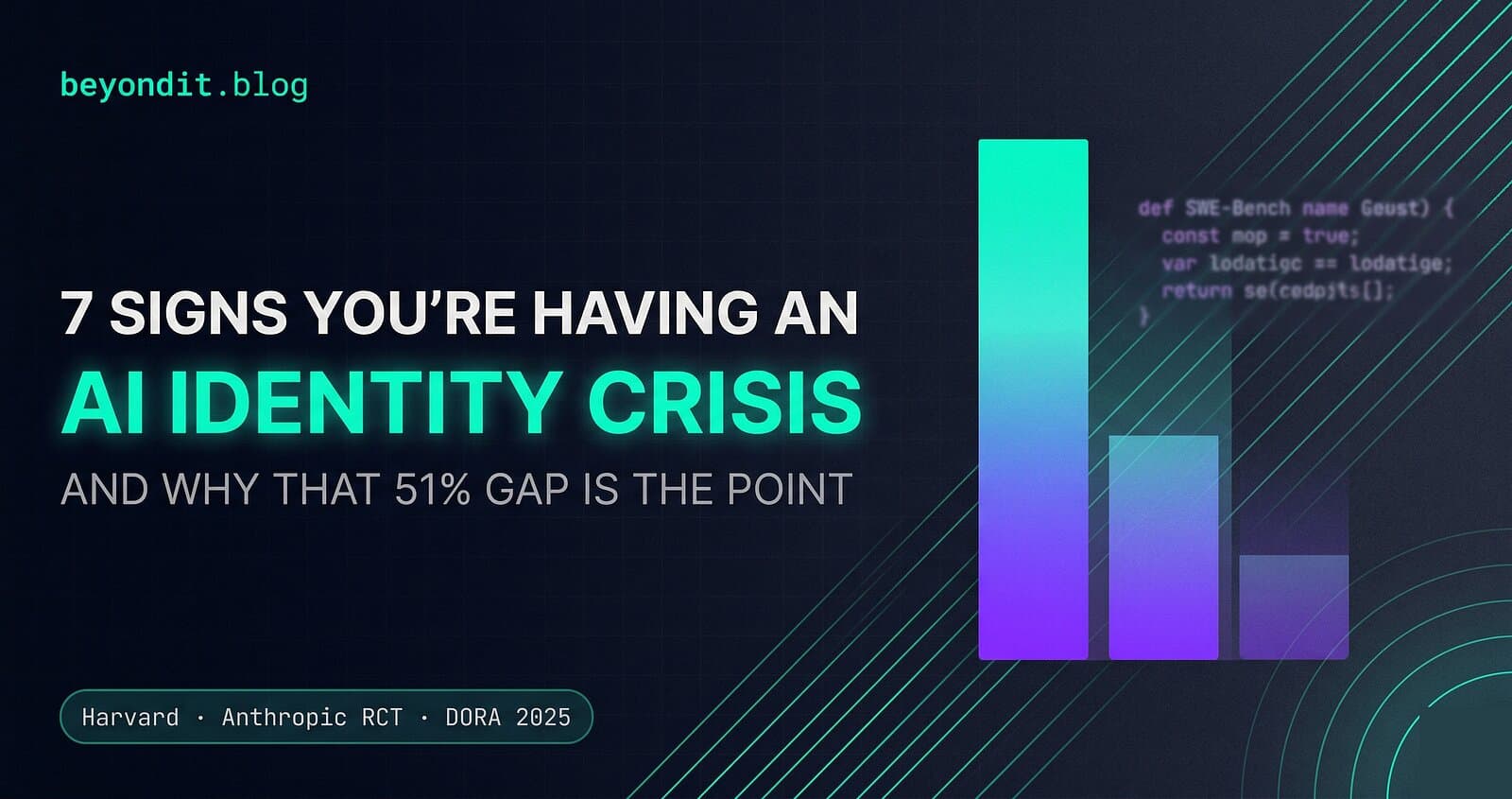
You're shipping faster than at any point in your career. And you feel less capable than ever. Stack Overflow's 2025 developer survey confirmed this: 84% of developers use AI tools daily — but only 33% trust the accuracy of those outputs. That 51-point gap is the numerical fingerprint of a profession in collective denial.
Sign 4 — The Comprehension Gap
Comprehension Debt is the gap between how much code exists in your production system and how much of it any human on your team actually understands. Anthropic's peer-reviewed RCT found developers using AI assistance scored 17% lower on follow-up comprehension assessments.
Sign 5 — The Prompt Amnesia
You've shipped code you cannot fully explain because the reasoning existed only in a chat window that closed the moment you ran the tests. GitClear found code churn has doubled.
Sign 6 — The Title Anxiety
Threads on r/ExperiencedDevs discussing the shift in daily engineering workflows routinely hit 40,000+ views. The anxiety isn't irrational. It's a rational response to an identity that has been structurally destabilised without an honest conversation.
Sign 7 — The Loyalty Contradiction
Anthropic's CEO declared software engineers might be obsolete within twelve months. His company then posted 117 open senior engineering roles, a 172% increase. The industry doesn't need fewer engineers. It needs different ones. Make sure you aren't stuck running blind compiler checks over LLM garbage data.
What the "Just Become an Orchestrator" Crowd Won't Tell You
Every article on the AI identity crisis ends identically: "Don't worry — just learn to direct agents and you'll be fine." In many cases, it's wrong.
Path C is not a failure state — it is a Strategic Market Transition. Research confirms a measurable segment of the profession is exiting — not from lack of talent, but because the specific role they trained for has been structurally deprecated by the market.
How to Audit Your Employer Before You Audit Yourself
Run the 5-Question Employer Readiness Test:
- Does your organisation have defined governance for agentic AI workflows in production?
- Is there a formal policy requiring prompt archiving alongside Git commits?
- Does your team have a dedicated SDLC review stage specifically for AI-generated output?
- Are senior engineers evaluated on architectural governance — or still primarily on PR throughput?
- Does leadership understand the difference between generation velocity and sustainable production velocity?
The Traps That Will End Your Career Quietly
The 2025 DORA report from Google found that a 90% increase in AI adoption correlates with a 154% increase in average PR size. AI isn't accelerating your reviews. It's generating a volume that makes meaningful scrutiny structurally impossible.
- The DORA Productivity Paradox: More AI → more code → more bugs, not fewer.
- The Security Blind Spot: Apiiro's Fortune 50 analysis documented a 10-fold monthly increase in security findings.
- The Secrets Sprawl: GitGuardian recorded 29 million leaked secrets in public GitHub commits — a 34% year-over-year increase. The leak rate in AI-assisted commits is double the baseline.
- The Licence Contamination Problem: AI models are trained on repositories carrying copyleft licences (like GPL). Your commercial product may carry obligations you've never agreed to.
- The Governance Vacuum: This is an active governance failure running in production systems right now.
[!IMPORTANT] CTO ACTION REQUIRED Add one mandatory question to every AI adoption review: "Do we legally own this?" Let Software Composition Analysis (SCA) with snippet-matching tools scan AI-generated output for licence provenance.
Comprehension Debt — The Technical Liability Nobody Is Tracking
Traditional technical debt is a conscious compromise. Comprehension Debt is categorically different. It's invisible, unintentional, and compounding exponentially.
🗂️ What a "Theory of the System" Document Looks Like:
It's not a wiki. It's a living ARCHITECTURE.md committed alongside your code. Three sections: Why, How, and What Changed.
Example:
## ARCHITECTURE.md - Example Entry

### Transaction Routing Module (v2.3 - November 2025)

**Why:** Replaced v1 routing because multi-currency payouts were hitting an ISO 4217 minor-unit rounding edge case.

**How:** Delegated to Claude Code with explicit constraint: "Use Decimal, not float..." Rejected first AI output - it used float internally. Regenerated.

**What Changed:** Switched from 3-decimal truncation to banker's rounding. Prompt archived in /docs/prompts/routing-v2.md.
This document is the "theory of the system" — and without it (or if you are relying solely on a CLAUDE.md file that the AI treats as optional), you're managing a codebase that only AI can read.
The Only 2 Skills That Will Still Be Worth $500k in 2028
The engineers best positioned to thrive in the AI era are not the prompt engineering experts. They're the ones who spent years studying the fundamentals that AI cannot reliably replicate under production pressure.
According to Levels.fyi compensation data for Staff and Principal engineers at Anthropic, total compensation regularly runs between $400,000–$900,000. Not for writing syntax — for the ability to reject fragile architectures under production pressure.
To recognise a subtle race condition in a concurrent payment pipeline that an AI produced with complete syntactic confidence, passing every unit test. For general-purpose software development, the commercial value of writing code manually has dropped closer to zero than at any point in the profession's history. The commercial value of knowing when the code is architecturally wrong has never been higher.
The One Decision That Separates the Augmented from the Replaced
The industry is not replacing software engineering. It is automating the mechanical execution of code whilst exponentially raising the value of engineering judgement.
Acting on it requires one decision: choose your identity path consciously, before your employer or the market chooses it for you.
The developers who won't have this crisis in 2028 are the ones who chose to accept the present tense in 2026 — not as a threat, but as a decision point.
"AI accelerates good engineering decisions at the same rate it accelerates bad ones. The bottleneck was never typing — it was always thinking." — beyondit.blog