
7 Reasons Top Engineering Teams Are Ditching MCP (Backed by the MCPGAUGE Study)
In this article
- The Universal AI Adapter That Is Quietly Breaking Production
- Why Top Engineering Teams Are Abandoning the Model Context Protocol
- Deconstructing the MCP Token Bloat Architecture
- Reverting to Token-Efficient Command Line Interfaces
- Architectural Anti-patterns Destroying AI Agent Reliability
- Future-Proofing Agentic Systems With Stateless Execution
Why are top engineering teams quietly ripping MCP out of their production stacks?
We all loved the idea of a universal AI adapter when it launched. But the operational reality is proving to be a massive, expensive headache.
And it's costing you more than just money.
TL;DR: The 3 Agent Architectures Defined
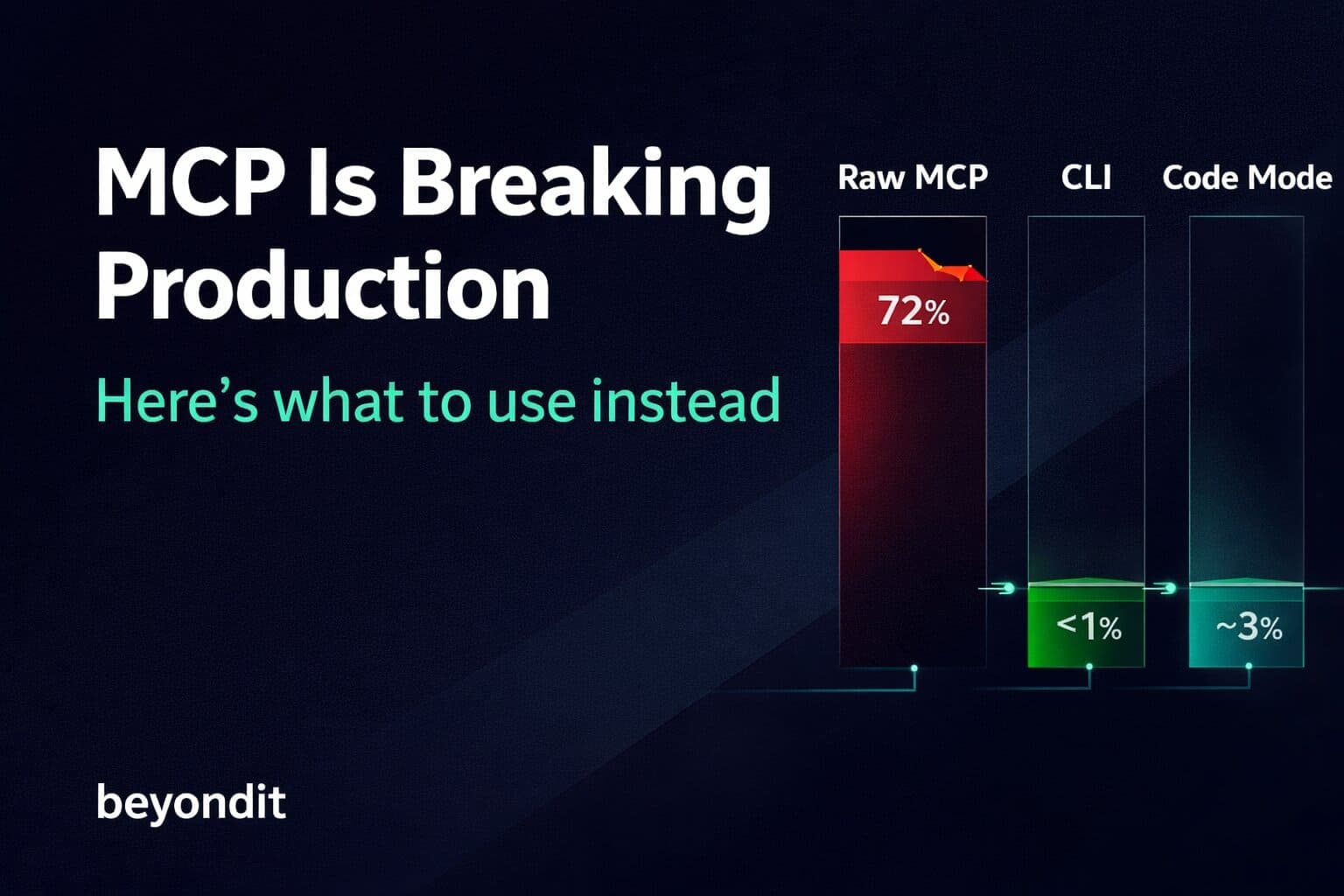
Raw MCP: The agent dynamically discovers tools at runtime by reading massive JSON schemas. High flexibility, but catastrophic token overhead.
CLI / Skills: The agent executes targeted bash scripts or opinionated Markdown commands. Zero schema overhead, highly deterministic, but requires manual tool wiring.
Code Mode MCP: The agent writes a one-off orchestration script that executes in a secure sandbox. Combines MCP's standardisation with the token efficiency of CLI — but requires dedicated infrastructure to run and audit.
The Universal AI Adapter That Is Quietly Breaking Production
The Model Context Protocol arrived with enormous promise. Anthropic positioned it as the "USB-C for AI" — a single, standardised layer letting any LLM plug into any tool, database, or enterprise system without bespoke integration code.
The ecosystem responded fast. MCP became a Linux Foundation project backed by major cloud providers. Thousands of community-driven servers appeared on directories like MCP.so almost overnight.
But production is where illusions get stress-tested.
The Illusion of the "USB-C for AI" Standard
Picture a senior engineer deploying an AI coding agent to automate pull request reviews. They initialise an MCP server connecting GitHub, Jira, and Slack. In development, it works beautifully.
In production, the agent starts failing silently. It returns contradictory analysis and misses obvious context.
The culprit isn't the model. It's the context window.
MCP's tool schema overhead had already consumed 72–74% of the available 200,000-token window before the agent processed its first real prompt. The "USB-C" metaphor is seductive but misleading — USB-C transfers data at near-zero overhead. MCP transfers metadata describing tools at a catastrophic cost.
The MCP Token Overhead Hidden in Every Production Deployment
The headline numbers are damning enough. But understanding why MCP produces this overhead matters.
This is a structural consequence of the protocol's design — not a bug that gets patched in the next release.
The MCPGAUGE benchmark paper (arXiv, August 2025) quantifies what engineers were already feeling: MCP integrations inflate input token volume by 3.25x to 236.5x depending on schema complexity. A corroborating network performance study (arXiv, October 2025) independently found 2x–30x prompt-to-completion token inflation across real-world MCP deployments.
To make that concrete: a single GitHub MCP tool — assign_copilot_to_issue — consumes 810 tokens on its own. Expose 2,500 endpoints and you're looking at upwards of 244,000 tokens of pure overhead before a single user task begins.
That's not a schema tax. That's the context window itself.
The schema overhead alone — before the agent processes its first useful token — costs approximately $1,600/day at scale: 44,026 tokens × Claude 3.5 Sonnet's $3.75/million input token pricing × 10,000 sessions. Pure waste, before a single line of useful work. When token bloat hits $1,600 a day for a single high-volume workflow, it's no longer an infrastructure quirk — it's a board-level cost problem.
And that is exactly why the smartest teams are jumping ship.
Why Top Engineering Teams Are Abandoning the Model Context Protocol
The breakaway from MCP isn't happening in blog posts. It's happening quietly — in production architecture reviews — where senior engineers stop asking "how do we use MCP?" and start asking "how fast can we replace it?"
Two signals in 2026 made this mainstream.
Garry Tan's Critique and the Shift to Opinionated Tools
Y Combinator's CEO Garry Tan didn't write a nuanced hot-take. He switched. His team built gstack — a set of opinionated workflow skills implemented as pure Markdown slash commands that embed senior engineering judgement directly into Claude Code workflows.
That's the key architectural distinction. Instead of letting an LLM discover tools at runtime through MCP schema negotiation, gstack encodes exactly what to do, in what order, with what constraints — as version-controlled, reviewable text files. Skills as code. It's not an MCP replacement; it's what happens when you stop trusting dynamic discovery and start trusting explicit workflow design.
Perplexity made the same MCP-replacement call. CTO Denis Yarats publicly noted that authentication friction across multiple MCP servers was degrading production reliability. Perplexity pulled major workflows off MCP entirely and routed them through conventional APIs using standard bearer tokens.
When YC and Perplexity make the same architectural decision in the same quarter, it's not a coincidence. It's a signal. One constraint to know upfront: gstack is Claude Code-specific. Teams on Cursor, Windsurf, or GitHub Copilot should implement the equivalent as version-controlled slash command libraries in their own toolchain.
The 1,000+ Unauthenticated Servers Security Crisis
This is the one that should worry your CTO more than any benchmark.
Security scans throughout 2025 found a rapidly escalating exposure problem. Trend Micro identified 492 servers with zero authentication in mid-2025, exposing 1,402 internal tools to anonymous external access. Bitsight's independent analysis found approximately 1,000 exposed servers by December 2025. The trajectory is accelerating — and there is no visible enforcement mechanism to reverse it.
Unlike a traditional API that returns data, an MCP server acts. It writes files. It triggers deployments. It sends messages. An unauthenticated MCP server isn't a data leak — it's an open control surface. Traditional edge security tools miss roughly 80% of internal agentic traffic — Shadow AI that bypasses conventional security tooling entirely.
Now here's the argument MCP defenders reach for: "But OAuth 2.1 is already in the spec." They're right. The MCP specification formalised OAuth 2.1 support in March 2025 — with scoped tokens, PKCE, and .well-known discovery. The spec exists.
But spec and production are different things. A March 2026 analysis of over 5,200 MCP deployments found that only 8.5% utilise OAuth — with 53% still depending on static API keys or personal access tokens. The 492–1,000 exposed servers aren't a spec failure. They're an adoption failure. And that gap doesn't close until MCP client libraries enforce it by default.
Deconstructing the MCP Token Bloat Architecture
The numbers tell you what's broken. The architecture tells you why it stays broken.
These aren't configuration mistakes you can tune away. They're structural.
How Token Bloat Makes Your Agent Dumber
Token overhead doesn't just cost money. It actively makes your agent dumber.
The MCPGAUGE study found MCP's context window tax degrades agent reasoning accuracy by an average of 9.5%. This aligns precisely with Stanford's "Lost in the Middle" research (Liu et al., 2024), which demonstrated retrieval performance drops of 15–47% as context load increases.
High token counts act as noise. The signal your agent needs — the actual task, the business logic, the relevant data — gets drowned out by thousands of tokens describing tool schemas it will never use in that session.
The Stateful Session Bottleneck Limiting Scalability
MCP's architecture relies on long-lived, stateful connections between the LLM and the tool server. Fine for a single developer on a local machine.
A scalability nightmare for enterprise deployments.
You can't horizontally scale a stateful session the same way you scale a stateless HTTP service. Every MCP server handling concurrent agents becomes a coordination problem — session state, race conditions, context consistency across parallel workflows. The official 2026 MCP roadmap explicitly names "Transport Evolution and Scalability" as its top priority. That work is underway. But until stateless horizontal scaling ships as a stable, production-grade feature, your architecture is built on a bottleneck.
And the bottleneck doesn't stop at scaling.
How Heavy Abstraction Layers Degrade Deterministic Execution — and Where Code Mode MCP Changes Everything
Here's the part MCP evangelists skip over.
Your agent called the wrong endpoint variant. The schema was ambiguous. You spent two hours debugging a tool-selection decision you didn't even know was happening. That's not a one-off — that's the architecture.
As Patrick Kelly put it in his March 2026 MCP vs CLI benchmark: "MCP is a primitive, not a strategy. MCP is infrastructure, like HTTP. HTTP doesn't make web apps fast. Architecture does."
MCP's dynamic tool discovery lets an LLM auto-select tools at runtime. But that lookup is inherently non-deterministic. And this is precisely where Code Mode MCP changes the calculus entirely.
Instead of exposing every tool directly to the LLM, Code Mode generates a typed programmatic interface from the MCP server's schema — then gives the agent a sandboxed execution environment and a minimal set of tools to discover, read, and run against that interface. Tool invocations are batched inside a script; the LLM context receives only the final result.
But here's the trade-off MCP evangelists also skip: Code Mode drastically slashes your LLM token costs whilst shifting that expenditure straight to your infrastructure. Running thousands of isolated sandboxed Worker V8 engines or Docker containers is not free — and in high-volume workflows, that infrastructure cost requires its own justification.
The mechanism varies by implementation: Cloudflare's production deployment uses a single TypeScript execution tool backed by a Worker sandbox with RPC bindings; Anthropic's reference implementation uses a three-tool filesystem discovery pattern; Block's Goose uses a search-and-execute variant. The pattern is what matters — not the specific tooling.
The outcome is concrete. Cloudflare collapsed 2,500 API endpoints to two tools and roughly 1,000 tokens of context. The peer-reviewed CE-MCP paper (arXiv:2602.15945) validates the pattern formally across 10 MCP servers: up to 98.7% token reduction vs. raw MCP and 56% fewer tokens than plain CLI on complex multi-step orchestration tasks.
CLI wins on discrete, high-frequency calls. Code Mode wins when the agent orchestrates looped, multi-tool workflows. Raw MCP loses both.
Before you commit: five things Code Mode won't fix for you (per Nordic APIs, December 2025):
- Infrastructure cost — every sandboxed execution spins up an isolated runtime; at scale, this Worker V8 or container cost must be explicitly budgeted against your LLM token savings
- Sandbox complexity — you're now operating or building a secure runtime with managed bindings, not just calling an API
- Debugging overhead — LLM-generated orchestration code can be buggy; reproducing a failure without re-running a full agent session is genuinely hard
- Compliance risk — HIPAA, SOC 2, and financial services contexts require stringent sandboxing audits before sign-off; the EU AI Act's high-risk system provisions take full effect August 2026 — agentic systems with LLM-generated code execution are a likely classification candidate in regulated EU deployments
- Human-in-the-loop gaps — Code Mode's sandboxed execution is only as safe as your approval gates; any external network request from the sandbox must route through a human-in-the-loop checkpoint in regulated environments
// Code Mode MCP — conceptual orchestration pattern
// PSEUDOCODE: illustrative pattern only — not a drop-in module.
// Cloudflare implementation: MCP server bindings injected via Worker env object (env.YOUR_MCP).
// Anthropic reference: use @modelcontextprotocol/sdk client directly.
// Full implementation guides:
//   blog.cloudflare.com/code-mode-mcp
//   anthropic.com/engineering/code-execution-with-mcp

async function runOrchestration(env) {
  // Note: Bindings must be scoped to READ_ONLY permissions at the infrastructure level

  // Step 1: Discover tools once — not on every call
  const tools = await env.GITHUB_MCP.listTools();
  const prTool = tools.find(t => t.name === "get_pull_request");

  // Step 2: Execute full workflow in a single sandboxed script
  const pr = await env.GITHUB_MCP.callTool(prTool.name, {
    repo: env.GITHUB_REPO,
    pr_number: env.PR_NUMBER
  });

  // Step 3: Return only the structured result — LLM context receives this only
  return JSON.stringify({
    title: pr.title,
    changed_files: pr.changed_files,
    additions: pr.additions,
    deletions: pr.deletions
  });
}
Reverting to Token-Efficient Command Line Interfaces
The shift back to CLIs isn't nostalgia. It's engineering discipline — specifically for high-frequency, discrete tool calls where each invocation is self-contained and the token cost per call is fixed.
That's the architecture. And it stays the default for discrete, high-frequency workflows until MCP's stateless scaling and OAuth client enforcement actually ship to production — not just to spec.
UNIX philosophy has always been the right model here: do one thing, do it well, pipe the output. In agentic workflows, that means the LLM consumes only the data it asked for — nothing more.
Building Composable Bash Scripts for Agent Workflows
The core principle is explicit control over the context string. Instead of letting an MCP server dynamically describe what it can do, a bash script returns precisely what the agent needs to know.
#!/bin/bash
# agent-pr-summary.sh — token-efficient PR summary for LLM consumption
# Usage: ./agent-pr-summary.sh <PR_NUMBER>
# Requires curl >= 7.76.0 (April 2021). Verify: curl --version
# macOS Monterey+ ships curl 7.77+ — safe by default.
# RHEL 7 (curl 7.29) / Ubuntu 18.04 (curl 7.58): replace --fail-with-body with:
#   curl -s -o /tmp/response_$$.json -w "%{http_code}" and check status manually.

set -euo pipefail

PR_NUMBER="${1:?Error: PR number required}"
REPO="${GITHUB_REPO:?Error: GITHUB_REPO env var not set}"
TOKEN="${GITHUB_TOKEN:?Error: GITHUB_TOKEN env var not set}"

# Exponential backoff to handle GitHub API rate limits during agent loops
MAX_RETRIES=3
RETRY_DELAY=2

for ((i=0; i<=MAX_RETRIES; i++)); do
  # Six fields only — not the full GH API blob (~200+ fields, ~8,000+ tokens)
  # --fail-with-body: non-zero exit on HTTP 4xx/5xx, error body preserved
  response=$(curl --fail-with-body --silent --show-error \
    -H "Authorization: Bearer ${TOKEN}" \
    -H "Accept: application/vnd.github.v3+json" \
    "https://api.github.com/repos/${REPO}/pulls/${PR_NUMBER}" 2>&1)

  exit_code=$?

  if [ $exit_code -eq 0 ]; then
    echo "$response" | jq '{
      title: .title,
      state: .state,
      body: .body,
      changed_files: .changed_files,
      additions: .additions,
      deletions: .deletions
    }'
    exit 0
  fi

  if [ $i -eq $MAX_RETRIES ]; then
    echo '{"status":"error","message":"API rate limit or connection failed after retries."}'
    exit 1
  fi

  sleep $RETRY_DELAY
  RETRY_DELAY=$((RETRY_DELAY * 2))
done
This returns six targeted fields instead of the 200+ field JSON blob the GitHub API produces. Your agent consumes roughly ~120 tokens for the response rather than several thousand.
That difference compounds across hundreds of tool calls per session.
Don't overload bash scripts with routing logic or business rules. If your script is branching across more than two decision paths, you've built a microservice in a trench coat. Build it properly — with tests and a defined interface.
Implementing Standard Bearer-Token Agent APIs
For anything more complex than a simple data fetch, a lightweight REST API with standard OAuth bearer-token auth is the right abstraction. It's the same pattern that has secured web services for fifteen years — stateless, auditable, and dead simple to reason about.
The key rule: each API call must be self-contained. No session state on the server. No persistent connection to manage.
One critical edge case most examples miss: curl returns exit code 0 even on HTTP 4xx and 5xx responses. If you don't handle that explicitly, your agent receives a 401 Unauthorized body and treats it as valid business data. The fix is --fail-with-body — available in curl ≥ 7.76.0, documented by curl's own maintainer — which forces a non-zero exit on any HTTP error whilst preserving the response body for agent error context.
#!/bin/bash
# agent-bearer-call.sh — stateless bearer-token authenticated agent API call
# Usage: ./agent-bearer-call.sh <endpoint_path>
# Requires curl >= 7.76.0. Verify: curl --version
# macOS Monterey+ safe by default.
# RHEL 7 / Ubuntu 18.04: see fallback pattern in agent-pr-summary.sh above.

set -euo pipefail

ENDPOINT="${1:?Error: endpoint path required}"
API_BASE="${AGENT_API_BASE:?Error: AGENT_API_BASE env var not set}"
TOKEN="${AGENT_API_TOKEN:?Error: AGENT_API_TOKEN env var not set}"

MAX_RETRIES=3
RETRY_DELAY=2

for ((i=0; i<=MAX_RETRIES; i++)); do
  response=$(curl --fail-with-body --silent --show-error \
    --max-time 30 \
    -H "Authorization: Bearer ${TOKEN}" \
    -H "Content-Type: application/json" \
    "${API_BASE}/${ENDPOINT}" 2>&1)

  exit_code=$?

  if [ $exit_code -eq 0 ]; then
    echo "${response}"
    exit 0
  fi

  if [ $i -eq $MAX_RETRIES ]; then
    # Covers network failures AND HTTP 4xx/5xx — curl exit 0 is not a success guarantee
    echo '{"status":"error","code":"'"${exit_code}"'","message":"API call failed. Stop current task. Await instruction.","detail":"'"${response}"'"}'
    exit 1
  fi

  sleep $RETRY_DELAY
  RETRY_DELAY=$((RETRY_DELAY * 2))
done
Perplexity's architectural shift to this pattern delivers the outcome: predictable auth, clean error surfaces, no stateful MCP server to babysit.
Structuring Ephemeral Agent Runtimes
Consider a CI/CD pipeline where an AI agent reviews code, runs tests, and generates a deployment summary. Instead of a persistent MCP server holding state across the entire pipeline run, each stage spins up an ephemeral agent process with a fresh context window.
It reads a structured handover contract, does its discrete task, writes its output, and terminates. No ambient session to corrupt. No context degradation accumulating across a four-hour run.
One thing that bites teams at this step: the AGENT_API_TOKEN is never visible in the prompt or the LLM's context. In a production ephemeral runtime, it must be injected into the isolated container via a secrets manager — HashiCorp Vault or AWS Secrets Manager using short-lived STS tokens. The agent executes the script; the infrastructure handles the authentication.
This is the pattern borrowed from serverless architecture. Each agent invocation starts with a clean slate and a structured brief — not a rotted transcript from hours ago. The overhead drops. The reliability goes up.
Architectural Anti-patterns Destroying AI Agent Reliability
Bad MCP architecture is obvious in hindsight. But these patterns are easy to fall into when the local demo is working beautifully.
The arXiv systematic analysis of MCP security (2025) confirmed all three failure modes below are exploitable at scale — not theoretical edge cases.
Treating Internal Firewalls as a Sufficient Security Perimeter
The assumption: "Our MCP server is behind the corporate firewall, so we don't need strict auth."
The reality: firewalls control network access — not action authorisation.
An employee with internal network access — or any compromised internal service — can invoke your unauthenticated MCP server and trigger real actions: file writes, API calls, message sends. Because traditional security tooling misses ~80% of internal agentic traffic, you won't see it in your logs. Every MCP server in your production environment needs bearer-token or SSO-integrated authentication. No exceptions. The firewall is not a substitute for application-layer authorisation.
Routing High-Frequency Data Retrieval Through Heavy Protocols
MCP is particularly ill-suited for operations that run frequently and need fast, targeted data.
Routing paginated database queries or high-frequency status checks through an MCP server is a direct path to token exhaustion. Each call re-sends the full tool schema. Do that fifty times in a single agentic workflow and your context window is gone before the real work starts.
Use a deterministic REST endpoint or CLI script for any operation called more than a handful of times per session. Reserve raw MCP for low-frequency, discovery-heavy integrations where the schema overhead is a one-time cost.
Failing to Implement Programmatic Wait States in CLI Wrappers
This one bites teams that move from MCP to CLIs and assume the hard problems are behind them.
⚠️ [WARNING] If an external API your CLI script calls hangs or times out, your agent won't wait patiently. It will time out and may hallucinate a successful execution rather than surface a clean failure. The agent moves on. Your pipeline corrupts silently.
#!/bin/bash
# Defensive CLI wrapper — prevents agent hallucination on hung or failed calls
# Requires curl >= 7.76.0. macOS Monterey+ safe by default.

set -euo pipefail

ENDPOINT="${1:?Error: endpoint required}"

response=$(curl --fail-with-body --silent --show-error \
  --max-time 30 \
  -H "Authorization: Bearer ${AGENT_API_TOKEN}" \
  "${ENDPOINT}" 2>&1)

exit_code=$?

if [ $exit_code -ne 0 ]; then
  echo '{"status":"error","code":"'"${exit_code}"'","message":"External call failed. Do not proceed. Await human instruction.","detail":"'"${response}"'"}'
  exit 1
fi

echo "${response}"
Always return a structured error object on failure. Give the agent a clear, unambiguous signal to stop — not silence it'll interpret as success.
Future-Proofing Agentic Systems With Stateless Execution
Let's address the objection directly: "MCP is improving. The roadmap is real. You're too early to write it off."
And honestly — they're right.
The three-act story of 2026 is this: raw MCP over-engineered the problem; CLI was the efficient tactical retreat; Code Mode is now the synthesis — keeping MCP's standardisation benefits whilst eliminating its token costs. The question is no longer "MCP or not" but "which pattern fits this workflow."
Anticipating the 2026 Streamable HTTP Roadmap
Streamable HTTP has already shipped as MCP's production transport standard — replacing the older stdio transport that forced developers to run tools as local sub-processes, and unlocking remote server deployments at scale. That's a real, meaningful step forward.
But running it at production scale has exposed a consistent new set of gaps. As the official 2026 MCP roadmap states directly: "stateful sessions fight with load balancers, horizontal scaling requires workarounds, and there's no standard way for a registry or crawler to learn what a server does without connecting to it."
The active 2026 priorities — stateless horizontal scaling, OAuth 2.1 client adoption enforcement, and .well-known metadata discovery — are the gap between a maturing protocol and a production-safe one. That work is underway. Until it ships as stable, verified features, the CLI-first architecture remains the defensible default for discrete, high-frequency workflows.
Prioritising Deterministic Control Over Opaque Ecosystems
The deeper lesson from 2026's "Great Decoupling" isn't that MCP is bad. It's that opaque ecosystems are dangerous at scale.
When your agent's behaviour depends on dynamic tool discovery, runtime schema negotiation, and stateful sessions you can't audit, you've traded control for convenience. That's acceptable in local development. It's unacceptable in production systems executing real business actions.
The CLI-first, bearer-token-auth approach isn't glamorous. But it gives you a fully auditable, deterministic execution path — where every tool call, every token consumed, and every action taken is explainable and reproducible.
In production engineering, explainable beats clever — always.
For a balanced perspective on where Code Mode complements rather than replaces MCP, Block's engineering team wrote the definitive counterpoint (December 2025). The Descope MCP vs CLI analysis (March 2026) and the peer-reviewed CE-MCP paper (arXiv:2602.15945) cover the full tradeoff space if you want to go deeper.
Use CLI when:
- You have >10 discrete, high-frequency tool calls per session
- Auth must be strict with full audit trails
- Execution must be deterministic and reproducible in CI/CD
- The task is self-contained and the output is predictable
Use Code Mode MCP when: (See Code Mode explanation above for mechanism, implementation variants, and infrastructure trade-offs)
- The agent orchestrates complex, multi-step or looped workflows
- Token budget is critical and raw MCP schema cost is unacceptable
- You need MCP's standardised tooling without per-step schema overhead
- You've addressed sandbox complexity, compliance requirements, runtime dependencies, and infrastructure cost
Avoid Raw MCP when:
- Calls are frequent — schema re-sends compound fast
- OAuth 2.1 client enforcement is not fully implemented in your stack
- You need horizontal scaling today — stateful sessions block it
- Execution must be deterministic — dynamic schema lookup is not
Code Mode definition: the agent writes a short orchestration script; a typed programmatic interface is generated from the MCP server's schema; the script executes in a sandboxed environment; only the final result returns to the LLM context. Cloudflare validated this at enterprise scale — 2,500 API endpoints, two tools, ~1,000 tokens. Source: Anthropic engineering blog (2025).
So — are you on raw MCP, CLI, or Code Mode in production right now? I want to hear which trade-off you landed on and why.