
10 JavaScript Data Structure Tricks to Ace Coding Interviews
In this article
- 1. Two-Pointer Magic: Finding Pairs in Linear Time
- 2. Sliding-Window Sprint: Max Subarray with Constant Space
- 3. Bitwise Flags: Compact & Lightning-Fast
- 4. WeakMap Caching: Memory-Safe Memoization
- 5. Proxy Validator: Guardrails for Robustness
- 6. Generator Linked-List Traversal: Lazy & Lean
- 7. Priority Queue (Min-Heap): Algorithmic Depth
- 8. Map-Based Caching: Simple & Effective Memoization
- 9. Typed-Array Buffers: Numeric Throughput Mastery
- Conclusion: Practice, Explain, and Own It
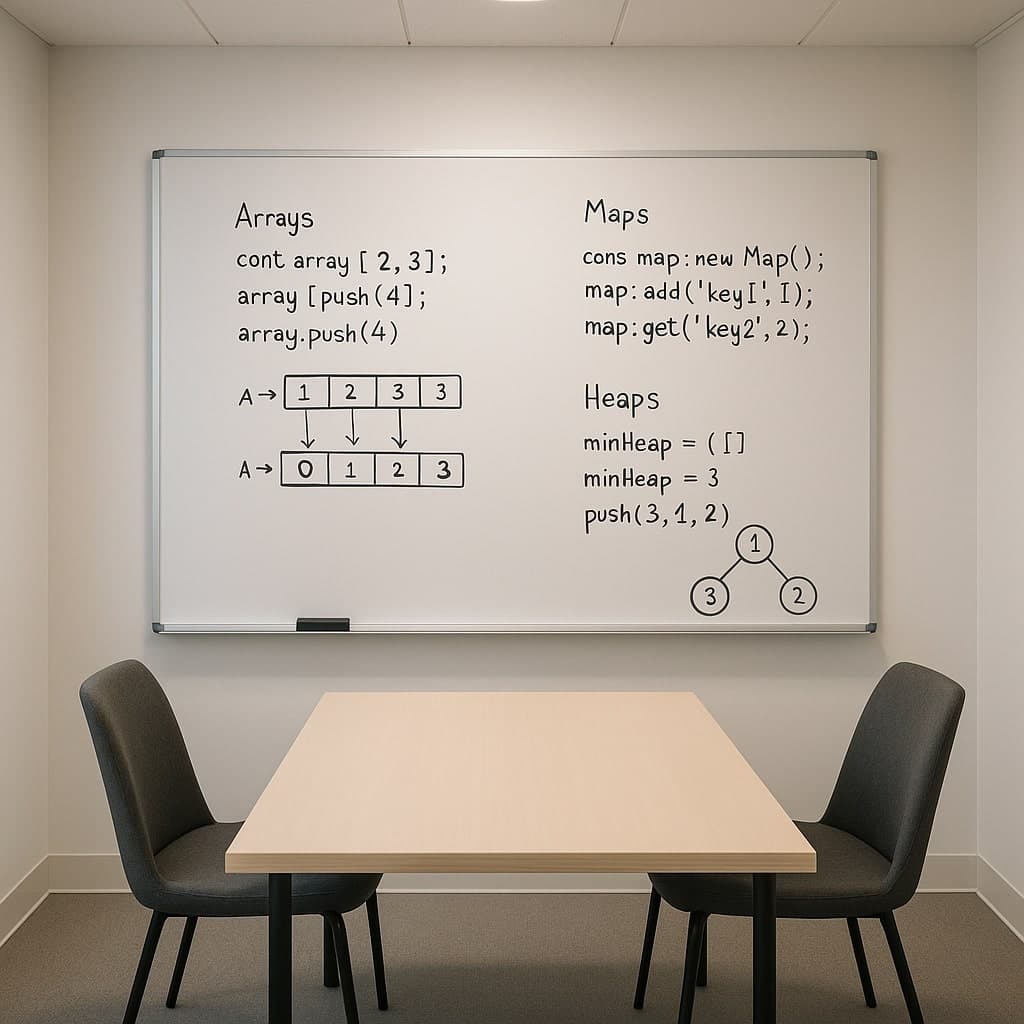
Picture this: you’re seated in a glass-walled interview room. An uneasy silence stretches as the interviewer sketches an array problem on the board. Your goal? Solve it elegantly in O(n) time, explain every step, and show you’re in the top 1% of candidates. That’s where these tricks come in. They aren’t academic exercises—they’re your toolkit for real coding rounds. Let’s dive in.
1. Two-Pointer Magic: Finding Pairs in Linear Time
Scenario: “Given an unsorted list of integers, find two numbers that add up to a target.”
Why It Matters: Naïve double loops cost O(n²). In an interview, that’s a red flag.
/**
 * Finds indices of two numbers that sum to a given target in O(n) time.
 */
export function twoSumPair(arr, target) {
  const map = new Map();
  for (let i = 0; i < arr.length; i++) {
    const complement = target - arr[i];
    if (map.has(complement)) {
      return [map.get(complement), i];
    }
    map.set(arr[i], i);
  }
  return null;
}
How It Works
-
As you loop once, store each value’s index in a
Map. -
For each new number, check if its “complement” is already seen.
-
Boom—instant O(1) lookup, no sorting required.
Pro Tip
On a sorted array, you can literally use two indices—one at the start, one at the end—to slide inward. Mention both in your interview for extra brownie points.
2. Sliding-Window Sprint: Max Subarray with Constant Space
Scenario: “Find the maximum sum of any contiguous subarray of size k.”
Real Talk: Interviewers love this: it tests your ability to maintain state efficiently.
/**
 * Returns max sum of any contiguous subarray of length k.
 */
export function maxSubarraySum(arr, k) {
  if (k > arr.length) return null;
  let maxSum = 0;
  for (let i = 0; i < k; i++) maxSum += arr[i];
  let tempSum = maxSum;
  for (let i = k; i < arr.length; i++) {
    tempSum += arr[i] - arr[i - k];
    maxSum = Math.max(maxSum, tempSum);
  }
  return maxSum;
}
Why It’s Elegant
-
You do one initial sum (O(k)), then iterate once.
-
Space stays at O(1).
-
In your explanation, draw the “window” sliding along the array—it’s a visual win.
3. Bitwise Flags: Compact & Lightning-Fast
Scenario: “Manage user permissions (read, write, execute) using minimal memory.”
Interview Hook: Everyone knows booleans—few know how to pack them.
export const READ  = 1 << 0; // 001
export const WRITE = 1 << 1; // 010
export const EXEC  = 1 << 2; // 100

export function hasPermission(flags, perm) {
  return (flags & perm) === perm;
}
export function addPermission(flags, perm) {
  return flags | perm;
}
export function removePermission(flags, perm) {
  return flags & ~perm;
}
Narrative:
“Imagine a 3-bit space on a whiteboard: 1 means ‘yes,’ 0 means ‘no.’ You flip bits, check bits, and never declare a sprawling object.”
4. WeakMap Caching: Memory-Safe Memoization
Scenario: “Cache expensive results keyed by objects without leaks.”
Why It’s Modern: WeakMaps let you avoid manual cleanup.
export function getWeakCached(obj, computeFn, cache = new WeakMap()) {
  if (cache.has(obj)) return cache.get(obj);
  const result = computeFn(obj);
  cache.set(obj, result);
  return result;
}
Story Angle:
“You build a React component or complex data model. On each re-render, you want to memoize—but you don’t want to hold onto stale keys. That’s where WeakMap wins.”
5. Proxy Validator: Guardrails for Robustness
Scenario: “Ensure object properties respect a schema and log every assignment.”
Why Interviewers Love It: Shows mastery of ES6 features.
export function createValidator(obj, schema) {
  return new Proxy(obj, {
    set(target, prop, val) {
      if (schema[prop] && !schema[prop](val)) {
        throw new TypeError(`Invalid value for ${prop}`);
      }
      console.log(`Setting ${prop} =`, val);
      target[prop] = val;
      return true;
    }
  });
}
“Say you’re building a game. You want health always an integer between 0 and 100. This proxy pattern nails it.”
6. Generator Linked-List Traversal: Lazy & Lean
Scenario: “Iterate a linked list on-demand without extra arrays.”
export function* listIterator(head) {
  let node = head;
  while (node) {
    yield node.value;
    node = node.next;
  }
}
Why It’s Clever:
“You demonstrate you can write your own iterator, discuss memory trade-offs, and show fluency with ES6 generators.”
7. Priority Queue (Min-Heap): Algorithmic Depth
Scenario: “Implement a scheduler or Dijkstra’s algorithm.”
export class MinHeap {
  constructor() {
    this.heap = [];
  }

  insert(val) {
    this.heap.push(val);
    this._bubbleUp();
  }

  extractMin() {
    if (this.heap.length === 0) return null;
    if (this.heap.length === 1) return this.heap.pop();

    const min = this.heap[0];
    this.heap[0] = this.heap.pop();
    this._bubbleDown();
    return min;
  }

  _bubbleUp() {
    let index = this.heap.length - 1;
    while (index > 0) {
      let parentIndex = Math.floor((index - 1) / 2);
      if (this.heap[parentIndex] > this.heap[index]) {
        [this.heap[parentIndex], this.heap[index]] = [this.heap[index], this.heap[parentIndex]];
        index = parentIndex;
      } else {
        break;
      }
    }
  }

  _bubbleDown() {
    let index = 0;
    while (true) {
      let leftChildIndex = 2 * index + 1;
      let rightChildIndex = 2 * index + 2;
      let smallestIndex = index;

      if (leftChildIndex < this.heap.length && this.heap[leftChildIndex] < this.heap[smallestIndex]) {
        smallestIndex = leftChildIndex;
      }

      if (rightChildIndex < this.heap.length && this.heap[rightChildIndex] < this.heap[smallestIndex]) {
        smallestIndex = rightChildIndex;
      }

      if (smallestIndex !== index) {
        [this.heap[index], this.heap[smallestIndex]] = [this.heap[smallestIndex], this.heap[index]];
        index = smallestIndex;
      } else {
        break;
      }
    }
  }
}
Interview Angle:
“Even if JavaScript lacks a native heap, you can code one in less than 30 lines—impressive on a timed exercise.”
8. Map-Based Caching: Simple & Effective Memoization
Scenario: “Cache pure-function results keyed by strings or numbers.”
export function getCached(key, fn, cache = new Map()) {
  if (cache.has(key)) return cache.get(key);
  const res = fn(key);
  cache.set(key, res);
  return res;
}
Real-World Hook:
“Think Fibonacci or heavy string parsing—memoization converts exponential to linear time.”
9. Typed-Array Buffers: Numeric Throughput Mastery
Scenario: “Process large numeric datasets or WebGL buffers.”
export function sumInt32Array(arr) {
  let sum = 0;
  for (let i = 0; i < arr.length; i++) sum += arr[i];
  return sum;
}
Why It Stands Out:
“Typed arrays live in contiguous memory—benchmark them against regular arrays, and you’ll see lower GC pauses and faster loops.”
Conclusion: Practice, Explain, and Own It
Each trick here is more than code—it’s a narrative. During your interview, walk through why you chose one pattern over another, sketch the data flow, share a micro-benchmark, and highlight complexity. That storytelling, paired with bulletproof code, is what truly separates you into the top 1% of candidates.